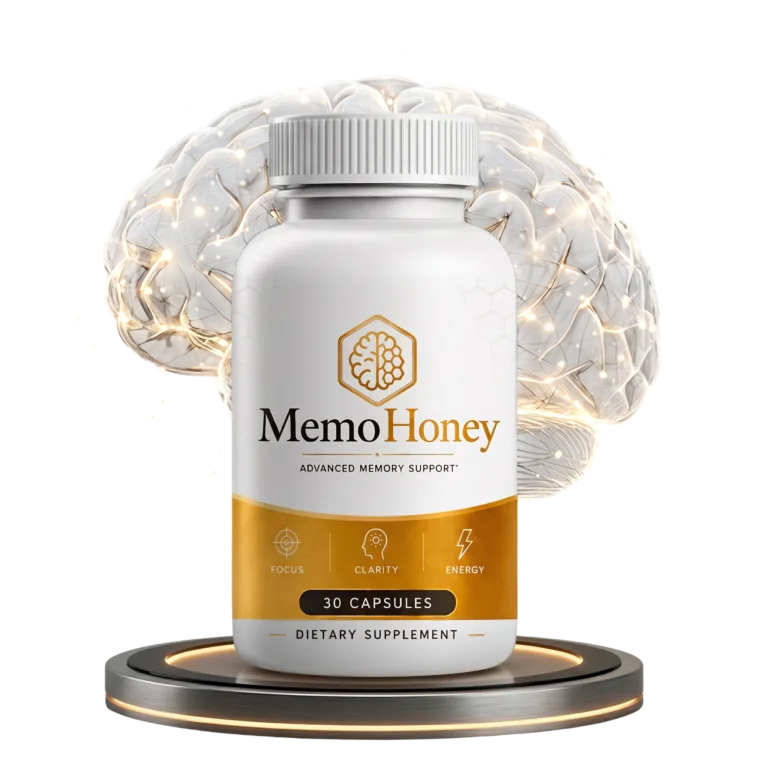
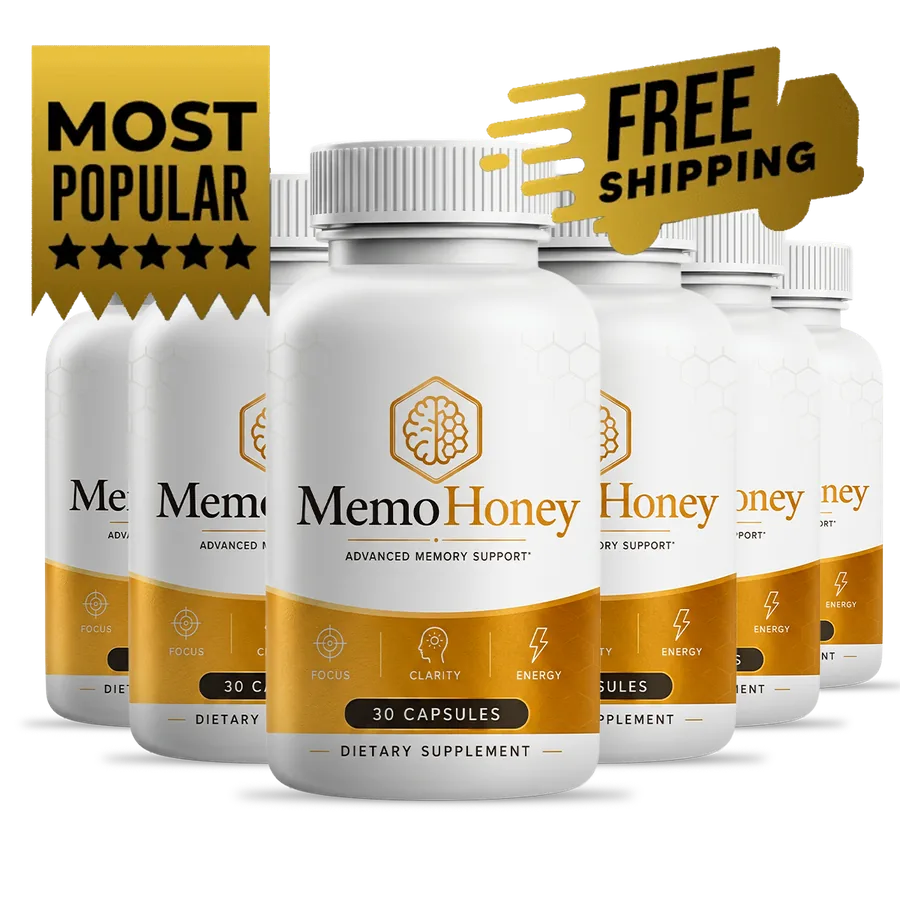
Every line on the MemoHoney supplement facts panel: what it is, the dose in one capsule, why formulas use it, and how much confidence the research deserves for memory and focus. Where the evidence is thin, we say so.
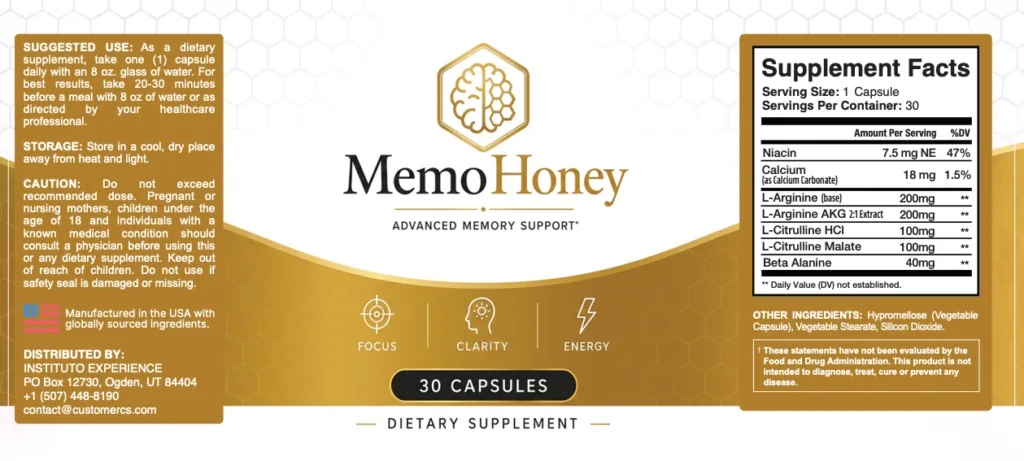
The supplement facts panel and directions, as printed on the bottle.
Reading the panel
Five of seven lines are amino acids
Two arginines, two citrullines. Same pathway, four labelled forms. Together 400 mg and 200 mg.
Beta-alanine at 40 mg. Exercise studies typically use several grams.
Niacin and calcium. A B vitamin at about 47% of the daily value and a trace of calcium.
No herbs, no caffeine listed. It's closer to sports nutrition than to a herbal brain blend.
The ratings below are our own plain-English read of published research, not medical advice and not from the manufacturer.
Ingredient by ingredient
What each line does, and what we can't say
Ratings show evidence for memory and focus specifically, out of five.
01 / 07
L-Arginine (base)
200 mg
●●○○○ limited for memory
What it is
A building-block amino acid your body also gets from protein foods such as meat, fish, dairy and nuts.
Why formulas use it
The body uses it to make nitric oxide, a molecule that helps blood vessels relax. Brands argue better blood flow could help the brain.
Our read
The nitric oxide pathway is real biology, and arginine has been studied for blood pressure and exercise. Evidence that it improves memory in healthy adults is limited. Studies often use grams a day, and this capsule carries 200 mg of the base form.
Heads-up
May lower blood pressure. Ask a pharmacist if you take blood pressure medicine, nitrates or erectile-dysfunction medicine. Can cause stomach upset.
02 / 07
L-Arginine AKG 2:1 extract
200 mg
●○○○○ limited
What it is
Arginine bound to alpha-ketoglutarate (AKG), a compound involved in cellular energy metabolism. The 2:1 means two arginine for each AKG.
Why formulas use it
Sports nutrition products use this form, and the pairing is marketed as a way to support nitric oxide and energy.
Our read
Most of the research is in exercise settings, with mixed results even there. We could not find strong evidence for effects on memory or focus.
Heads-up
Same cautions as arginine: possible blood pressure effects and stomach upset.
03 / 07
L-Citrulline HCl
100 mg
●●○○○ limited for memory
What it is
An amino acid found in watermelon. The body converts it to arginine in the kidneys.
Why formulas use it
Because it becomes arginine, formulas pair it with arginine to keep nitric oxide production going.
Our read
Some studies show citrulline raises blood arginine levels effectively, and it has been tested for blood pressure and exercise. Results for cognition in healthy people are sparse. Doses in trials are usually grams, not 100 mg.
Heads-up
Generally well tolerated. Occasional stomach discomfort. Same blood pressure caution as arginine.
04 / 07
L-Citrulline Malate
100 mg
●●○○○ limited for memory
What it is
Citrulline bound to malate, a compound involved in energy metabolism. A common form in sports supplements.
Why formulas use it
Used in pre-workout products for endurance and reduced muscle soreness.
Our read
Its best evidence concerns exercise performance, not memory. Having two citrulline forms on the label is a formulation choice, but the combined amount is still only 200 mg of citrulline compounds per capsule.
Heads-up
Occasional stomach discomfort. Check with a pharmacist if you take blood pressure or heart medicines.
05 / 07
Beta-Alanine
40 mg
●○○○○ very limited at this dose
What it is
A non-essential amino acid. The body uses it to build carnosine, which buffers acid in muscle.
Why formulas use it
Best known as an endurance supplement. Some brands also describe it as an antioxidant for the brain.
Our read
Exercise studies typically use several grams a day taken for weeks. 40 mg is a tiny fraction of that, so do not assume the research applies. Evidence for memory benefits is minimal.
Heads-up
Tingling skin (paresthesia) is common at much larger doses and unlikely at 40 mg.
06 / 07
Niacin (vitamin B3)
7.5 mg NE
●●●●○ established nutrient
What it is
An essential B vitamin found in meat, fish, peanuts and fortified cereals. NE means niacin equivalents.
Why formulas use it
Cells use it to make NAD, a molecule involved in turning food into energy.
Our read
If you are low in niacin, correcting that matters. For people who already get enough, there is no good evidence that a little extra improves memory. 7.5 mg is about 47% of the daily value.
Heads-up
The flushing people associate with niacin is mainly reported at far higher intakes.
07 / 07
Calcium (as calcium carbonate)
18 mg
●○○○○ nutrient, tiny amount
What it is
An essential mineral that you mostly get from dairy, leafy greens and fortified foods.
Why formulas use it
Calcium plays a part in nerve signalling, which is the reason for including it in the copy.
Our read
18 mg is about 1.5% of the daily value, so it will not move the needle on your intake. It may also be there for formulation reasons.
Heads-up
No concerns at this amount. Count it if you take other calcium supplements.
The verdict
The formula as a whole
The idea behind MemoHoney is that more nitric oxide helps blood vessels relax and improves blood flow, which might help the brain. That is a plausible story and an unproven one. Most of the research on these ingredients is about exercise and blood pressure, and the amounts studied are generally much larger than one capsule contains.
A reasonable expectation is a modest effect at best, and for many people none. That doesn't make it a bad product to test. It means testing it with the money-back guarantee in mind.
If you take prescription medication, have a medical condition, are pregnant or nursing, or are under 18, speak with your doctor or pharmacist first. The label says the same. Our safety notes list the interactions worth knowing.
Plans
Where to get it
Official order-page pricing, checked November 2026. Checkout shows the final price.
Niacin has the firmest footing as an essential vitamin, but extra niacin is not shown to boost memory in people who already get enough. Arginine and citrulline are well studied for blood pressure and exercise, with much less evidence for memory.
Does MemoHoney contain caffeine?
Caffeine is not on the supplement facts panel. The label lists seven lines: niacin, calcium, two forms of arginine, two forms of citrulline and beta-alanine.
Does MemoHoney contain bacopa, ginkgo or other herbs?
Not according to the label we reviewed. Some web pages describe herbal ingredients, but the supplement facts panel and the official page list only the amino acids, niacin and calcium. Always check the panel on your own bottle.
How many capsules a day?
One. The label says to take one capsule daily with an 8 oz glass of water, 20 to 30 minutes before a meal, and a bottle holds 30 capsules.